Insight
The Problem With
Wearables in Senior CareThe Problem With Wearables
in Senior Care
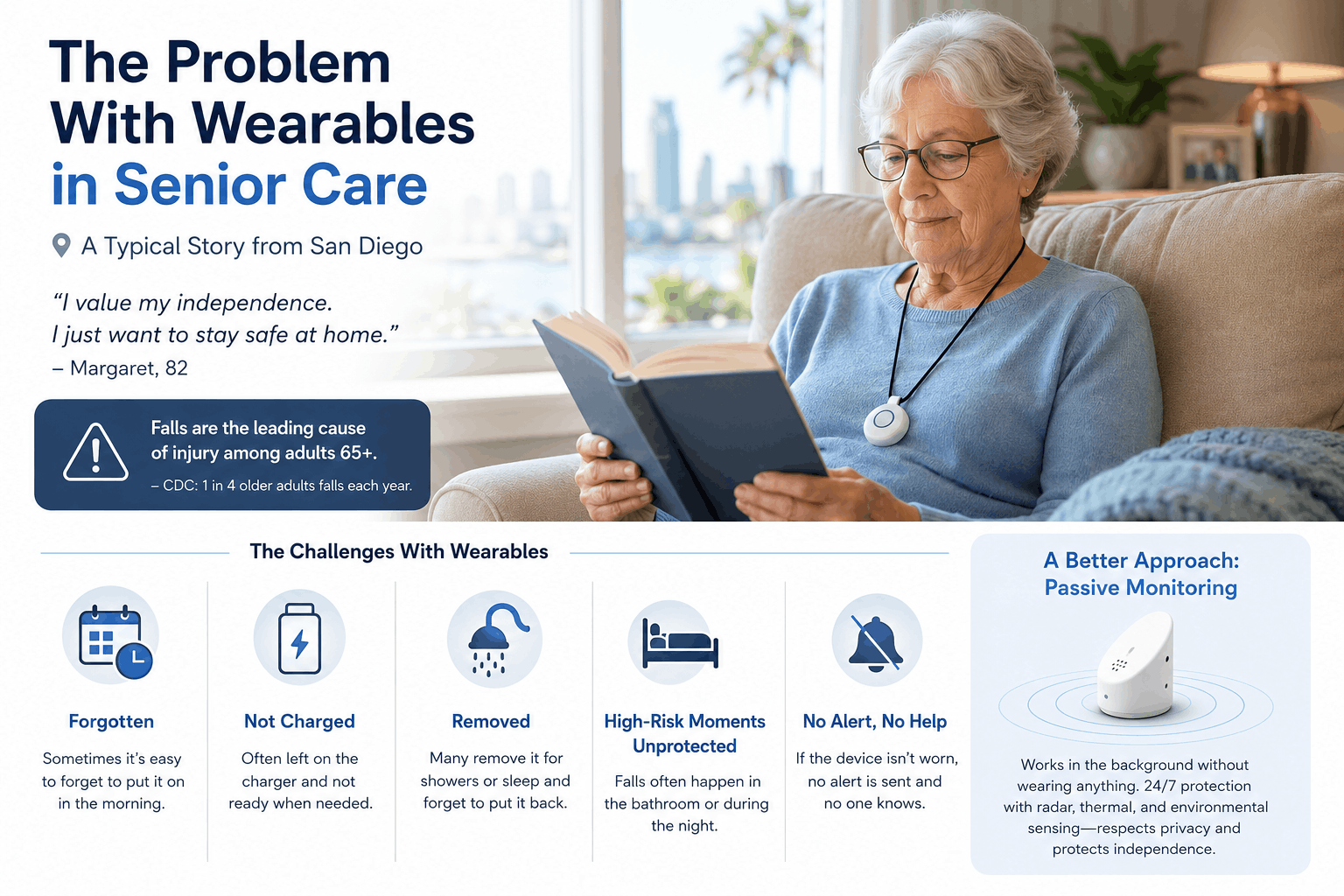
Margaret is 82 years old and lives alone in San Diego.
Like many older adults, she values her independence. She enjoys reading in her favorite chair, tending to her small garden, and staying connected with her family.
A year ago, her daughter purchased a wearable emergency pendant for her.
At first, Margaret wore it every day.
But over time, things changed.
Sometimes she forgot to put it on in the morning.
Sometimes she left it charging on her nightstand.
Other times she removed it before taking a shower and simply forgot to put it back on.
One evening, Margaret got up to use the bathroom.
As she stepped onto the bathroom floor, she slipped and fell.
Fortunately, the fall was not severe.
Unfortunately, her emergency pendant was sitting on the charger in her bedroom.
No alert was sent.
No family member was notified.
No one knew she needed help.
Margaret eventually managed to reach a phone, but the experience left her family asking an important question:
What happens when the device isn't being worn?
This challenge is not unique to Margaret.
Across the senior care industry, wearable devices continue to provide valuable protection. However, their effectiveness depends entirely on one thing:
Consistent usage.
A device that is forgotten, removed, or left on a charger cannot protect anyone.
This is why many senior care professionals are beginning to explore passive monitoring technologies.
Instead of relying on a person to remember a device every day, passive monitoring systems work automatically in the background.
Radar sensing, thermal sensing, and environmental monitoring technologies can help detect falls, long-lie events, and changes in activity patterns without requiring older adults to wear, charge, or interact with a device.
The goal is not to replace caregivers.
The goal is to provide protection even when people forget.
Because emergencies rarely happen at convenient times.
And safety should not depend on whether a device is being worn at that exact moment.
Note: Margaret is a fictional character used to illustrate a common challenge in senior care technology.